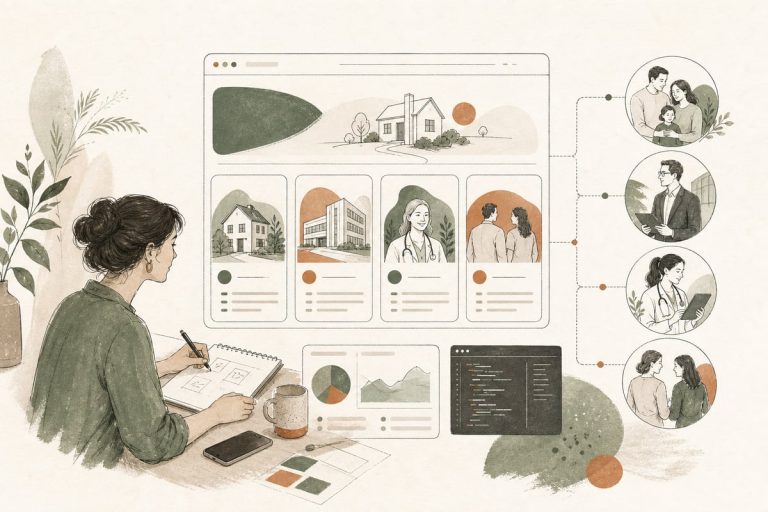
Should Your Small-Business Website Have Separate Pages for Each Customer Type?
If your business serves different kinds of customers, separate pages for each audience can improve conversions, clarify your offer, and bring in better leads. The key is not creating extra pages just to have more pages, but building the right pages for audiences with different questions, needs, and buying triggers.
Why this matters more than most small businesses realize
Many small-business websites describe services well enough, but they do not speak directly to the person reading. A homeowner, a property manager, a referring attorney, and a nonprofit director may all need the same core service, yet each one evaluates your business differently.
When all of those people land on the same generic page, a few problems show up:
- visitors have to figure out whether you are really for them
- your message stays broad instead of persuasive
- your examples feel less relevant
- your calls to action feel vague
- you attract more mixed-quality leads
Separate audience pages can fix that by matching your message to the visitor’s situation.
What “separate customer-type pages” means
These are pages built for distinct audiences, even when the service itself overlaps.
Examples:
- a contractor with separate pages for homeowners and commercial property managers
- a law firm with pages for injured workers, employers, and referral attorneys
- a clinic with pages for self-pay patients, insurance patients, and physician referrals
- an IT company with pages for small offices, medical practices, and nonprofits
- a cleaning company with pages for residential recurring service and office cleaning
This is not the same as making separate pages for every city or duplicating your service page with a few swapped words. The point is to address different buying concerns, not pad your sitemap.
When separate audience pages are worth it
Create separate pages when the audiences differ in ways that affect the sale.
Good reasons include:
1. They ask different questions before contacting you
A homeowner may ask:
- How quickly can you come out?
- What does this usually cost?
- Will you explain the process simply?
A commercial client may ask:
- Are you licensed and insured at the required level?
- Can you handle multiple locations?
- Do you coordinate with facility managers?
If those concerns are meaningfully different, separate pages help.
2. They care about different proof
Different audiences trust different signals.
Examples:
- homeowners want reviews, photos, warranties, and easy communication
- clinics may want compliance awareness, reliability, and support process
- referral partners may want responsiveness, professionalism, and status updates
- nonprofits may want budget clarity and long-term support
If one page cannot present the right proof to all groups without becoming cluttered, split it.
3. Your services are packaged differently for each audience
If your offer changes by audience, your page should too.
Examples:
- residential vs. commercial pricing structures
- one-time service vs. monthly retainers
- emergency work vs. planned projects
- direct-to-consumer vs. referral-based workflows
4. You want better lead quality, not just more traffic
Audience pages can help pre-qualify people. A good page does some sorting before the lead ever reaches you.
That means fewer inquiries from people who are not a fit and more from people who understand how you work.
When separate pages are probably not worth it
Do not create audience pages just because the idea sounds strategic.
You may not need them if:
- the same message works for all buyers
- the service, pricing, process, and proof are nearly identical
- you do not have enough real content to make each page useful
- you are already struggling to maintain your current pages
- the pages would become thin, repetitive, or confusing
A weak set of audience pages can hurt more than help. Visitors may feel lost, and Google may see near-duplicate content.
A simple decision test
Ask these five questions:
- Do these customer types use different language?
- Do they have different objections or concerns?
- Do they need different examples, testimonials, or case types?
- Does the offer or process change for them?
- Would a tailored page help me close more of the right leads?
If you answer yes to at least three, separate pages are usually worth exploring.
What to put on an audience-specific page
A strong audience page should not just rename the homepage headline. It should make the reader feel understood quickly.
Here is a practical structure:
1. A clear headline for that audience
Examples:
- Web design for medical practices that need faster updates and better patient inquiries
- Commercial landscaping for property managers who need reliable multi-site service
- Family law representation for parents dealing with urgent custody issues
2. A short intro that names their situation
Show that you understand what makes this audience different.
For example:
- their timelines
n- their budget pressures
- their approval process
- their documentation needs
- their communication expectations
3. The specific services or outcomes they care about
Do not list everything you do. Emphasize what matters most to that audience.
4. Relevant proof
Use the most relevant:
- testimonials
- project examples
- before-and-after visuals
- industries served
- certifications or qualifications
- process details
5. A simple explanation of how working with you goes
This reduces uncertainty and improves conversion.
6. FAQs just for that audience
This is often where audience pages become much more useful than generic service pages.
7. A matching call to action
Examples:
- Request a site visit
- Book a consultation
- Ask about multi-location service
- Talk with our team about referral coordination
SEO benefits and trade-offs
Separate audience pages can help SEO, but only when they reflect real search intent and useful content.
Possible SEO upside
They can help you rank for more specific searches such as:
- commercial electrician for property managers
- website design for law firms
- nonprofit web development support
- pediatric clinic website maintenance
They also help search engines and AI answer tools understand exactly who you serve.
The trade-offs
There are real risks:
- thin pages with mostly repeated content
- internal competition between similar pages
- extra maintenance whenever services change
- confusing navigation if too many audience options are created
A smaller number of strong pages beats a large number of weak ones.
How to avoid making these pages feel repetitive
This is where many websites go wrong. They create three pages with nearly identical copy and different audience labels.
To make pages genuinely distinct, change:
- the headline and page promise
- the examples used
- the FAQs
- the process details
- the common objections addressed
- the CTA
- the imagery
- the proof points
If most of that stays the same, you probably do not need separate pages.
Best audiences to consider first
If you want to test this approach, start with the audience that is either:
- most profitable
- easiest to close
- most common
- currently underserved by your website
For many small businesses, one or two audience pages is enough to start.
Examples:
- residential and commercial
- consumers and referral partners
- small businesses and nonprofits
- general patients and specialty-referral patients
You do not need a huge content build to see results. You need the right pages for the right segments.
A practical rollout plan
If you think your website needs audience pages, use this process:
Step 1: Identify your top 2 to 4 customer types
List the groups you actually want more of, not every group you have ever served.
Step 2: Write down what is different about each one
For each audience, note:
- what they want most
- what they worry about
- what proof they trust
- how they describe the problem
- what makes them contact now
Step 3: Compare that against your current pages
See whether your existing service pages already answer those needs.
Step 4: Build one page first
Do not launch six at once. Start with the audience most likely to improve lead quality or close rate.
Step 5: Track lead quality, not just traffic
Watch for:
- more relevant inquiries
- fewer bad-fit leads
- better conversion rates from that page
- improved time on page and engagement
The real buyer-focused question
The real question is not whether more pages are always better. It is whether your best-fit customer feels like your website is speaking directly to them.
If your business serves distinct audiences with different priorities, separate pages can make your website more persuasive and more useful. That often leads to better leads, smoother sales conversations, and less wasted time.
If your audiences are basically the same, keep the site simpler and strengthen the main service pages instead.
Frequently asked questions
Will separate audience pages confuse visitors?
Not if they are organized clearly. Good navigation, clear labels, and strong internal links help people find the version most relevant to them.
Can I use audience pages even if the service is the same?
Yes, if the buyer concerns are different. The service can overlap while the messaging, proof, and CTA change meaningfully.
Are these pages good for local SEO?
They can be, but they should not replace strong service and location pages. Audience pages work best when they target buyer intent, not just keywords.
How many audience pages should a small business have?
Usually one to three is enough to start. More than that only makes sense if you truly serve distinct segments with different needs.
What if I am not sure whether I need them?
Start by reviewing your leads. If you keep hearing different questions from different buyer types, that is a strong sign your website may need separate audience pages.
If you want help deciding whether your website should stay simple or add audience-specific pages, book a free consultation at https://webmasterandmore.com/consultation.